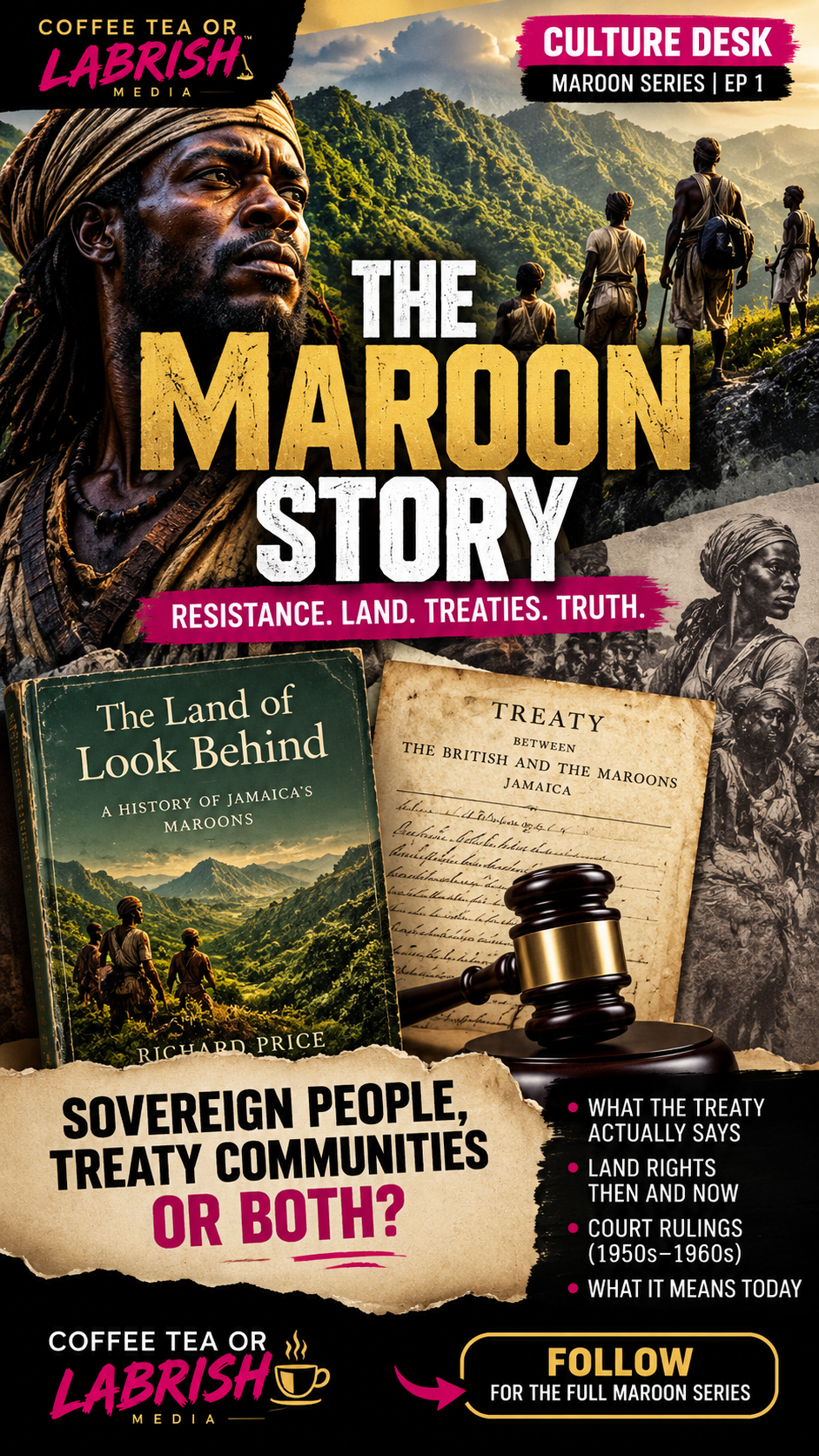
I have returned to the Maroon story more than once. I bought The Land of Look Behind. I said I was going to study the history more deeply. Then grief interrupted the work, and the book sat there while life moved in another direction.
This series is me returning to what I said I would do.
I am returning as a Jamaican, as a history teacher and as someone who knows that the version we learn first is usually the beginning of the investigation, not the end of it.
The heroic version of the Maroon story is powerful. People escaped enslavement, built communities in terrain that colonial soldiers struggled to penetrate and fought hard enough that the British came to the negotiating table. That part deserves to be remembered.
But if we stop at victory, we miss the harder questions.
Watch the Maroon Series
Watch “Uncovering Jamaica's Maroon Secrets: Part 1/8” on YouTube →
The treaty was an admission of colonial limits
By 1739, British colonial forces had not been able to destroy the major Maroon communities. The terrain mattered. Strategy mattered. Maroon knowledge of the land mattered. So did the fact that these communities had already built lives beyond plantation control.
The agreement associated with Cudjoe and the Leeward Maroons recognized freedom, set aside land and established a form of internal governance. A separate agreement followed with the Windward Maroons.
That is why the treaty cannot be understood as a gift from Britain. Freedom was not handed down by a generous government. It was negotiated after resistance made continued war too costly.
The document records British power, but it also records the point where that power failed.
Freedom came with conditions
The same agreement that recognized Maroon freedom also placed limits around it.
The treaties required the Maroons to end hostilities, assist colonial authorities under certain conditions and return people who escaped enslavement after the agreements. That last obligation remains one of the most painful parts of the history.
This is where a simple hero story becomes a political story.
The Maroons had secured their own freedom inside a society still organized around slavery. The treaty protected their communities while tying them to the machinery that kept other Black people unfree.
That contradiction does not erase the resistance. It tells us what colonial power often does when it cannot fully defeat an opponent: it negotiates, recognizes part of the opponent's claim and then builds new obligations around the recognition.
Were the Maroons sovereign?
This is the question that continues to shape public debate.
The treaties recognized land, leadership and a measure of internal authority. Maroon communities maintained their own traditions, leadership structures and collective identity. Those facts support the argument that the relationship was more than ordinary local administration.
But sovereignty is not one magic word that settles every dispute.
There is a difference between a people maintaining political identity, a treaty community holding particular rights and an independent state exercising complete authority. The Maroon experience contains elements of all three conversations, but the categories do not fit together neatly.
That is why the strongest question is not whether the Maroons were simply sovereign or simply subjects. The stronger question is how Maroon autonomy was negotiated, limited, defended and reinterpreted across different periods of Jamaican history.
The land is not a background detail
The Maroon story is inseparable from place.
Cockpit Country was not scenery. Its limestone hills, caves, valleys and difficult passages shaped military strategy and helped communities survive. The landscape became part of resistance.
Land also became part of the treaty settlement. That means modern conversations about boundaries, ownership, environmental protection and government authority cannot be separated from the historical documents.
When people ask who controls Maroon land today, they are not asking a new question. They are asking a modern version of the same question the treaty tried to manage: who has the authority to decide what happens here?
The treaty is a living argument
For many Maroons, the treaty is not only an archival object. It is a source of identity, legitimacy and political memory.
For the Jamaican state, Maroon communities exist within the constitutional and legal order of an independent country.
Those positions do not always produce the same answer.
The disagreement is not proof that the history is useless. It is proof that the history still has power.
A treaty signed under colonial rule can carry several meanings at once. It can be evidence of victory, evidence of compromise, a promise of land, a record of obligation and the starting point for a modern legal dispute.
What everybody else may be missing
The Maroon story is often used to make people feel proud or uncomfortable. It should make us think.
Resistance does not guarantee a clean ending. Survival can require compromises that later generations have to examine honestly. A community can win freedom and still be forced into a relationship with the system it resisted.
That is not a reason to flatten the Maroons into heroes or villains.
It is a reason to study the treaty as a political document and the Maroons as people making decisions under pressure.
CTOL Verdict
Jamaica's Maroon treaties are proof of resistance strong enough to force negotiation. They are also records of the limits, bargains and contradictions that followed. The honest history holds both truths at the same time.
CTOL Cups
☕☕☕☕☕ Essential context
Five cups because the treaty deserves to be read beyond the legend. Land, freedom, obligation and authority all live inside the same document.
The work continues
This article launches the CTOL Maroon Series and supports the research behind The Maroons: Children of Resistance, a proposed short documentary, Brooklyn screening and public conversation.
The goal is not to repeat the safest version of the story. It is to follow the documents, listen to Maroon voices and ask what the history means now.
Before You Leave the Culture Desk
Sign the Guestbook
Do the treaties make Jamaica's Maroons sovereign people, treaty communities or both?